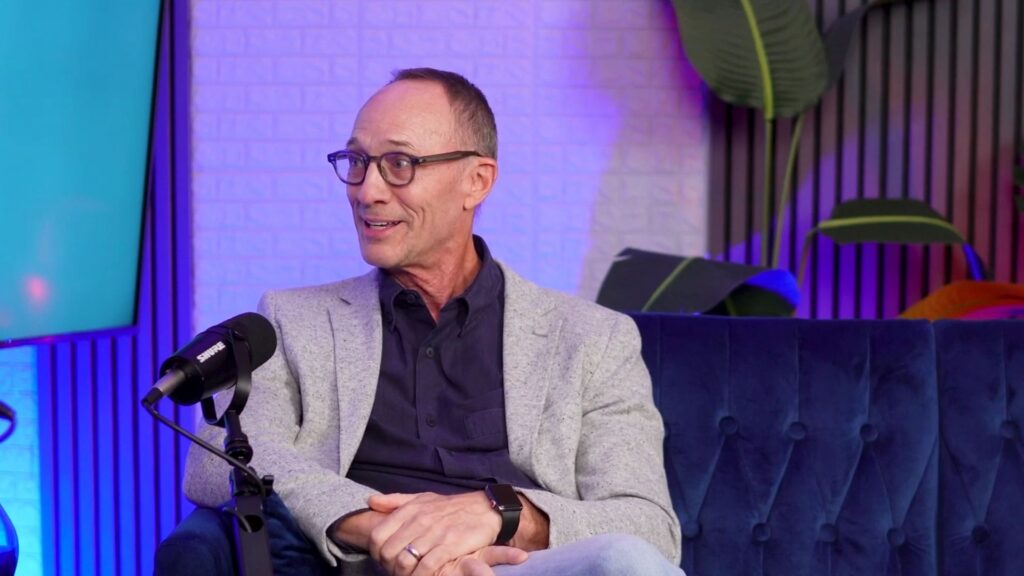
What if creativity is simply the human instinct to keep moving forward when faced with uncertainty? We like to think of creativity as a gift, a force that descends upon us when inspiration strikes. But what if it’s not? To respond to a blank page, an uncharted space, a crisis, or a border that splits people in two?
“Creativity is what you do when you don’t know what to do.”
Rick Archer offers this definition as if it’s the simplest truth in the world.
And maybe it is.
In this second conversation with Navigating Complexity, Rick isn’t here to talk about the early days of Overland Partners or the personal journey that led him to redefine architecture. He’s here to talk about what comes next. About the spaces where design collides with politics, where built environments become battlegrounds for ideology, and where the simple question of “how do we shape the world?” becomes infinitely more complicated when the world refuses to stand still.
One of the most pressing issues Rick explores is the future of the U.S.-Mexico border. Laredo and Nuevo Laredo were once one city, one people, until an arbitrary line drawn in 1848 divided them. Over time, that division hardened into a political and physical reality. Now, the Rio Grande—a river meant to give life—has become a barrier, polluted and neglected due to industrial waste, agricultural runoff, and inadequate sewage treatment from both sides of the border. The rapid industrialization along the U.S.-Mexico border, fueled by trade agreements like NAFTA, led to a boom in maquiladoras—factories that operate with minimal environmental regulations, discharging untreated waste into the river. Additionally, inadequate infrastructure in border towns has resulted in untreated sewage flowing directly into the Rio Grande. Commerce has slowed, communities have suffered, and the story of two cities has become a story of two separate fates.
Rick and his team have been tasked with an audacious vision: to transform the border into something else entirely. Instead of a place of division, what if it could be a place of connection? The project proposes a 1,000-acre conservation park, stretching across both nations—500 acres in the U.S., 500 in Mexico—a shared space that restores the river, revitalizes economies, and reconnects communities.
To say this is a radical idea is an understatement. Rick knows the political climate is volatile. He acknowledges that both political parties have failed to offer a real solution. He knows that proposing a bridge in a time of walls is controversial. But his response is simple: “Do you want to make a statement, or do you want to make a difference?”
Statements are easy. They flare up and burn out in the endless cycle of outrage and debate. A difference, however, requires something else—work, listening, compromise. It requires asking better questions. What does security really mean? Can control and connection coexist? Is a border meant to be a blockade or a threshold?
Engaging Border Patrol in discussions yielded a surprising result—they were in favor of the project. They saw how reimagining the border could help, not hinder, security efforts. It turns out that safe, legal crossing points and economic stability reduce the chaos of unregulated migration. Cleaning up the river makes surveillance easier and a thriving, activated space makes a city safer than an abandoned, neglected one.
Rick’s approach to architecture has always been about more than buildings. His firm designed the largest homeless center in the world, not because they wanted to build shelters, but because they wanted to create pathways out of homelessness. They designed Child Safe, a center for abused children, not as a sterile institution but as a place of dignity and healing. And now, they are tackling one of the most politically charged landscapes in the country, using the tools they know best: vision, collaboration, and an unrelenting belief that spaces should serve the people who inhabit them.
Rick doesn’t just critique systems—he asks how they might be different. He wonders what would happen if we started seeing the blank spaces in front of us not as obstacles, but as opportunities. And he knows that real transformation begins with the simplest, most difficult thing: the courage to imagine a better way.
If creativity is what we do when we don’t know what to do, then what possibilities are waiting just beyond our fear? What if the real barrier isn’t a border, but the limits of our own imagination?
Rick Archer invites us to consider the world not as it is, but as it could be. The question is—are we ready to build it?
To hear more about Rick Archer’s inspiring journey tune in to his episode of Navigating Complexity. “Building Bridges in a Time of Walls”
What if creativity is simply the human instinct to keep moving forward when faced with uncertainty? We like to think of creativity as a gift, a force that descends upon us when inspiration strikes. But what if it’s not? To respond to a blank page, an uncharted space, a crisis, or a border that splits people in two?
“Creativity is what you do when you don’t know what to do.”
Rick Archer offers this definition as if it’s the simplest truth in the world.
And maybe it is.
In this second conversation with Navigating Complexity, Rick isn’t here to talk about the early days of Overland Partners or the personal journey that led him to redefine architecture. He’s here to talk about what comes next. About the spaces where design collides with politics, where built environments become battlegrounds for ideology, and where the simple question of “how do we shape the world?” becomes infinitely more complicated when the world refuses to stand still.
One of the most pressing issues Rick explores is the future of the U.S.-Mexico border. Laredo and Nuevo Laredo were once one city, one people, until an arbitrary line drawn in 1848 divided them. Over time, that division hardened into a political and physical reality. Now, the Rio Grande—a river meant to give life—has become a barrier, polluted and neglected due to industrial waste, agricultural runoff, and inadequate sewage treatment from both sides of the border. The rapid industrialization along the U.S.-Mexico border, fueled by trade agreements like NAFTA, led to a boom in maquiladoras—factories that operate with minimal environmental regulations, discharging untreated waste into the river. Additionally, inadequate infrastructure in border towns has resulted in untreated sewage flowing directly into the Rio Grande. Commerce has slowed, communities have suffered, and the story of two cities has become a story of two separate fates.
Rick and his team have been tasked with an audacious vision: to transform the border into something else entirely. Instead of a place of division, what if it could be a place of connection? The project proposes a 1,000-acre conservation park, stretching across both nations—500 acres in the U.S., 500 in Mexico—a shared space that restores the river, revitalizes economies, and reconnects communities.
To say this is a radical idea is an understatement. Rick knows the political climate is volatile. He acknowledges that both political parties have failed to offer a real solution. He knows that proposing a bridge in a time of walls is controversial. But his response is simple: “Do you want to make a statement, or do you want to make a difference?”
Statements are easy. They flare up and burn out in the endless cycle of outrage and debate. A difference, however, requires something else—work, listening, compromise. It requires asking better questions. What does security really mean? Can control and connection coexist? Is a border meant to be a blockade or a threshold?
Engaging Border Patrol in discussions yielded a surprising result—they were in favor of the project. They saw how reimagining the border could help, not hinder, security efforts. It turns out that safe, legal crossing points and economic stability reduce the chaos of unregulated migration. Cleaning up the river makes surveillance easier and a thriving, activated space makes a city safer than an abandoned, neglected one.
Rick’s approach to architecture has always been about more than buildings. His firm designed the largest homeless center in the world, not because they wanted to build shelters, but because they wanted to create pathways out of homelessness. They designed Child Safe, a center for abused children, not as a sterile institution but as a place of dignity and healing. And now, they are tackling one of the most politically charged landscapes in the country, using the tools they know best: vision, collaboration, and an unrelenting belief that spaces should serve the people who inhabit them.
Rick doesn’t just critique systems—he asks how they might be different. He wonders what would happen if we started seeing the blank spaces in front of us not as obstacles, but as opportunities. And he knows that real transformation begins with the simplest, most difficult thing: the courage to imagine a better way.
If creativity is what we do when we don’t know what to do, then what possibilities are waiting just beyond our fear? What if the real barrier isn’t a border, but the limits of our own imagination?
Rick Archer invites us to consider the world not as it is, but as it could be. The question is—are we ready to build it?
To hear more about Rick Archer’s inspiring journey tune in to his episode of Navigating Complexity.