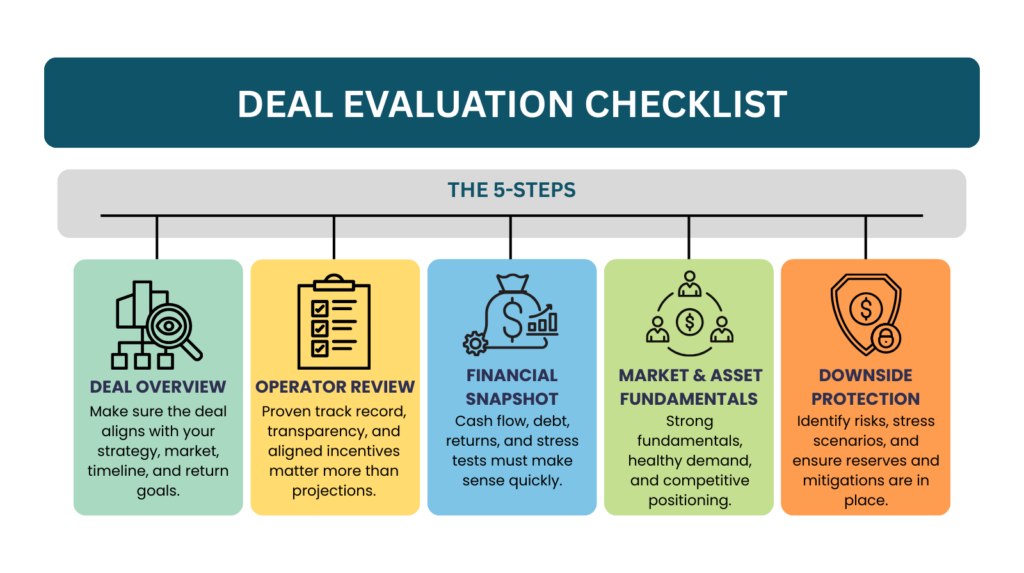
Every investor needs a repeatable way to assess deals quickly and confidently. Whether you’re underwriting a multifamily property, evaluating a development opportunity, or reviewing a private placement as an LP, this 5-step checklist will help you filter deals, avoid unnecessary risk, and focus your energy on the opportunities that actually deserve it.
Think of this as your first-pass filter — a structured way to determine whether a deal deserves deeper underwriting.
1. Deal Overview: Does This Fit My Investment Thesis?
Before touching the numbers, make sure the opportunity aligns with your strategy.
Questions to ask:
- Is the asset type aligned with your thesis? (Multifamily, industrial, development, etc.)
- Is it in a market you understand or have conviction in?
- Does the business plan make sense for current market conditions?
- Does the timeline match your return horizon?
- Is this a cash-flow play, value-add play, or appreciation-driven deal?
If it doesn’t fit your thesis, say “no” immediately. Discipline beats enthusiasm.
2. Operator Review: Who’s Actually Running This Deal?
People matter more than pro formas.
What you’re looking for:
- Proven track record in this specific asset class
- Transparency in communication
- Operational competence (not just acquisition competence)
- References or past investor feedback
- Alignment: Do they have their own capital in the deal?
- Are their assumptions historically realistic?
A great operator can salvage an average deal.
A bad operator can wreck a great one.
3. Financial Snapshot: Do the Numbers Make Sense?
You should be able to understand the financial picture in minutes.
Quick items to check:
- Projected cash flow starting Year 1
- Total capitalization & capital stack (equity vs. debt)
- Stabilized return metrics (CoC, IRR, equity multiple)
- Debt terms: interest rate, amortization, DSCR, covenants
- Stress tests: What happens if rents drop? If cap rates expand?
If the numbers feel too optimistic or debt feels too aggressive, walk away.
4. Market & Asset Fundamentals: Is the Property Positioned to Win?
The deal sits inside an asset, and the asset sits inside a market. Both matter.
Market-level checks:
- Population growth & job growth
- Supply pipeline vs. demand
- Rent growth trends
- Major employers & industry diversification
- Tenant quality and demographic shifts
Asset-level checks:
- Occupancy rates
- Current rent vs. market rent
- Property condition & deferred maintenance
- Location quality (micro and macro)
- Competition and comparable properties
Strong markets hide mistakes. Weak markets expose them.
5. Downside Protection: How Does This Deal Lose Money?
Great investors aren’t optimistic — they’re prepared.
Ask the operator (and yourself):
- What are the top three risks?
- What mitigations are in place?
- What happens if interest rates move against us?
- What if the exit cap rate is higher than projected?
- Is there enough cash cushion to weather volatility?
- Are reserves properly budgeted?
If you understand the downside and are comfortable with it, you’re ready for deeper due diligence.
Final Filter: Should You Move to Full Underwriting?
After Step 5, one of three things should happen:
1. “This is a clear NO.”
Move on quickly.
2. “This might work, but needs more analysis.”
Proceed to full underwriting and operator calls.
3. “This fits my thesis and passes all filters.”
You’ve found a deal worth serious attention.
This checklist helps you eliminate 90% of deals immediately — so you can focus your time and capital on the 10% that actually move the needle.