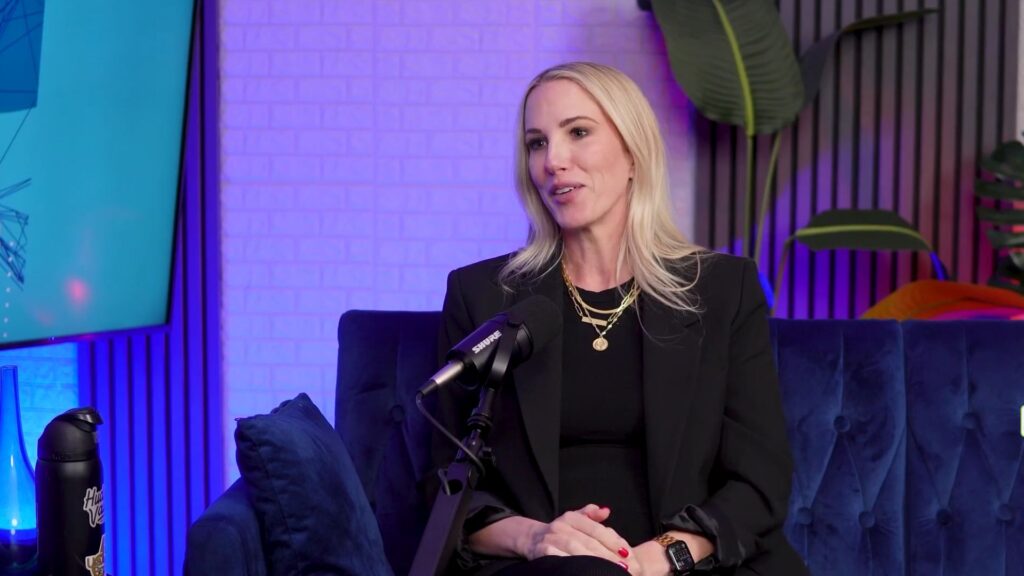
“Everything’s gonna work out. And you don’t need a man.”
That’s what Chelle Neff would tell her younger self today. A message wrapped in a little bit of humor, but means every word. But, of course, it didn’t always feel that way.
Chelle grew up in a living van, raised by parents battling addiction, taking care of her younger brother—who would later end up in prison. Her childhood was shaped by instability, a constant cycle of moving, making do, and finding ways to survive in a world that offered little safety. She wasn’t just a child; she was a caretaker, a problem-solver, the one who held things together when everything else fell apart. She learned to navigate her parents’ unpredictable behavior, to stretch every dollar, to read the room before walking into it. “I grew up fast because I had to,” she says. “There was no other choice.”
Despite the chaos, there were glimpses of something different. She remembers visiting a childhood friend whose family owned a small business, and for the first time, she saw a different way of living—one where stability wasn’t a dream but a daily reality. “I didn’t know people lived like that.”
That moment planted a seed: maybe life didn’t have to be reactive. Maybe she could create something of her own. If she wanted something different, she would have to build it herself. Survival was never guaranteed, and stability was a foreign concept. She learned to be resourceful early, not because she wanted to, but because she had to.
She started working at Supercuts as a teenager, an experience she describes as a “sweatshop for hairstylists”, where she was expected to cut four heads of hair an hour. It was grueling, but it taught her speed, endurance, and how to talk to just about anyone. But the real lesson wasn’t about cutting hair—it was about control. She realized that as long as she worked for someone else, she was at their mercy: their pay structures, their schedules, their policies.
At 27, she opened Urban Betty, a two-person salon in Austin, and suddenly found herself running a business she hadn’t quite prepared for. “I didn’t want to be anyone’s boss,” she admits. “That freaked me out.” She didn’t understand payroll, employment laws, or financial planning. When she hired her first employee, she panicked—until her CPA aunt casually mentioned QuickBooks. That’s it? Chelle thought. She could do this. Or at least, she could figure it out.
What she couldn’t figure out was how to trust her own success. Coming from poverty, the idea of making money felt foreign, almost wrong. “I grew up believing the rich get richer and the poor get poorer. I had to unlearn that.”
She found herself sabotaging her own growth, pricing services too low, hesitating to charge what she was worth. She didn’t feel entitled to financial success because, deep down, she wasn’t sure she deserved it. It took years—and a lot of therapy—to rewrite that internal script.
And then there were the setbacks. The business was growing, but not always in the right ways. She was stuck in a booth rental model, which gave stylists independence but left her struggling with inconsistent revenue and a lack of workplace culture. After eight years of financial instability, she made the difficult choice to transition to a commission-based model—which finally allowed her to build a salon that worked not just for clients, but for her stylists, too.
Of course, not every business decision was a success. One of her biggest failures? Launching a personal product line, a move that seemed like the logical next step but turned into a financial disaster. “If you have a successful service business, don’t start your own product line,” she laughs. “I have $30,000 of shampoo sitting in a warehouse.” She had underestimated the logistics, cash flow demands, and competition—a humbling lesson in just because you can do something doesn’t mean you should.
Through it all, she refused to quit. Chelle also learned something crucial along the way: getting comfortable with being uncomfortable. She realized that challenges don’t disappear with success—if anything, they evolve. The stress, the uncertainty, the pressure to make the right decisions never goes away. What changes is your tolerance for it. “Everything is hard at first, but then you lean into it. You start to recognize that feeling—fear, discomfort, the unknown—and instead of running from it, you push through. That’s where the growth happens.”
“Why did I keep going? Ego. A thousand percent ego.” She says it with a smile, but there’s truth in it. Ego, when unchecked, can drive bad decisions. But it can also keep you standing when everything is telling you to sit down. And for Chelle, that ego wasn’t about arrogance—it was about survival.
Today, Urban Betty is a multimillion-dollar brand with three locations and nearly 100 employees. The same woman who once panicked over payroll now offers health insurance, retirement plans, and leadership training. But success hasn’t erased her insecurities—it has simply changed the shape of them. Employees leave to start their own businesses. People whisper that she’s too successful, that she’s too ambitious. But she’s done caring about what others think. “Everything’s gonna work out. And you don’t need a man.”
And maybe, just maybe, she never needed permission to take up space in the first place.
To hear more about Chelle Neff’s inspiring journey tune in to her episode of Navigating Complexity.