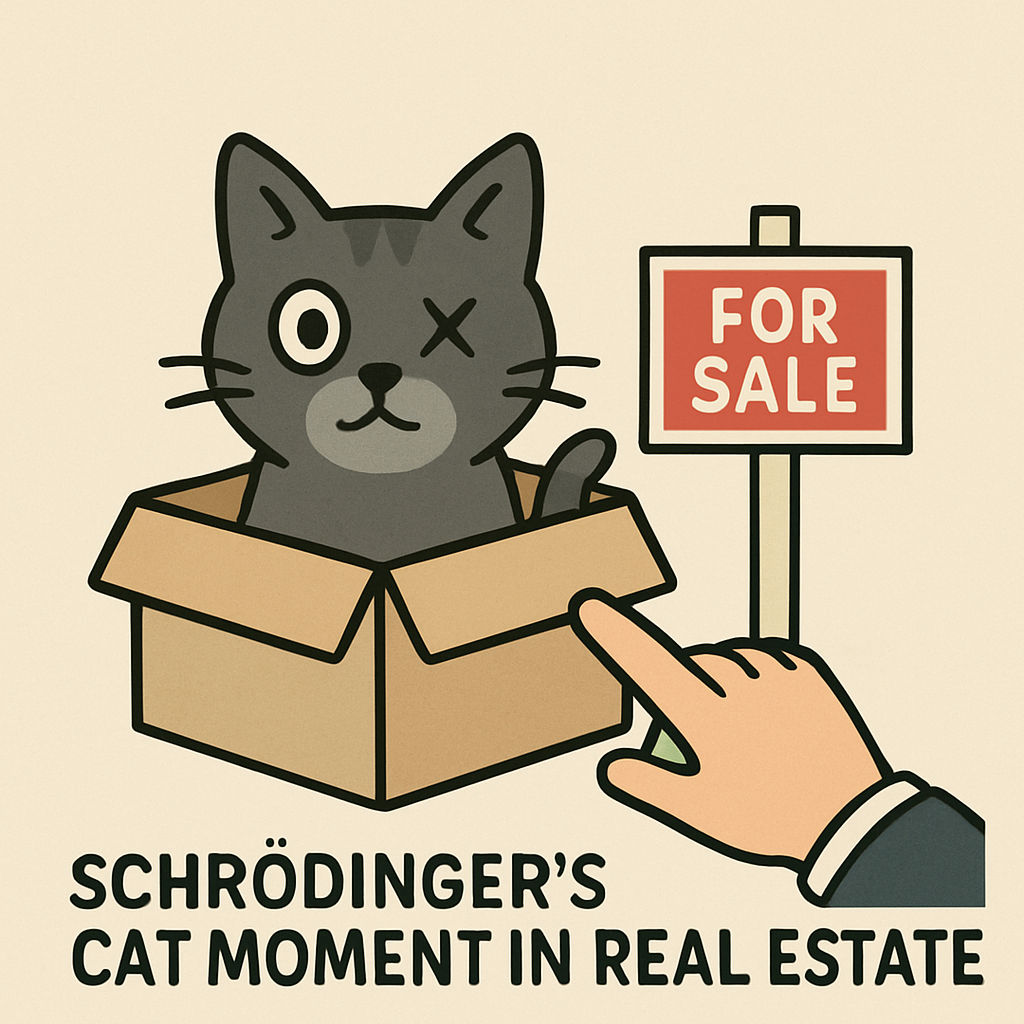
The classic thought experiment from quantum mechanics provides one of the best frameworks for thinking about today’s real estate market.
In the experiment, we’re asked to imagine a box with a cat in it and a vial of poison which will be released if a random, but probabilistic quantum event takes place, say the decay of a particular atom. This thought experiment was devised in part to show the absurdity of applying quantum mechanics to macro, or Newtonian objects like a cat.
According to quantum mechanics that cat is neither alive nor dead while sealed in the box because until such time an observer sees or measures whether the particular atom has decayed it is inherently unknowable whether the cat is alive or dead. You have to open the box to find out.
This feels absurd to most of us who have direct experience with cats since they are clearly either alive or dead regardless of whether we open the box and not in some quantum superposition.
Commercial real estate in 2025 feels very similar. Any given asset like the cat is in an in between state of being alive or dead. For example, is the multifamily property that you built last year worth the $80M you paid or perhaps a lot less (dead) or a lot more (alive)? The only way to find out is by observing the value directly through a transaction.
But with very little transaction data, and a strong desire by most owners not to kill their project by observing the actual market value through a sale, many projects delivered in the last couple of years are living in the same probabilistic superposition as the cat.
Measure it and you’ll find out if it’s alive or it’s dead. Don’t measure it and you can continue to live in a surreal state of limbo for a while longer.